
Answers to questions about civil defence shelters and protection
This page provides answers to common questions about civil defence shelters and protection. Finland is currently not under any military threat. There is no need to take defence shelters into use.
A civil defense shelter is a space with strong structural protection, its own ventilation system, an emergency exit, and essential equipment. Finnish civil defense shelters are designed to provide protection against weapon effects, building collapse, radiation, and toxic substances.
The civil defense shelter system is part of society’s resilience and preparedness. Shelters have been built in Finland for over 60 years, resulting in approximately 50,500 shelters.
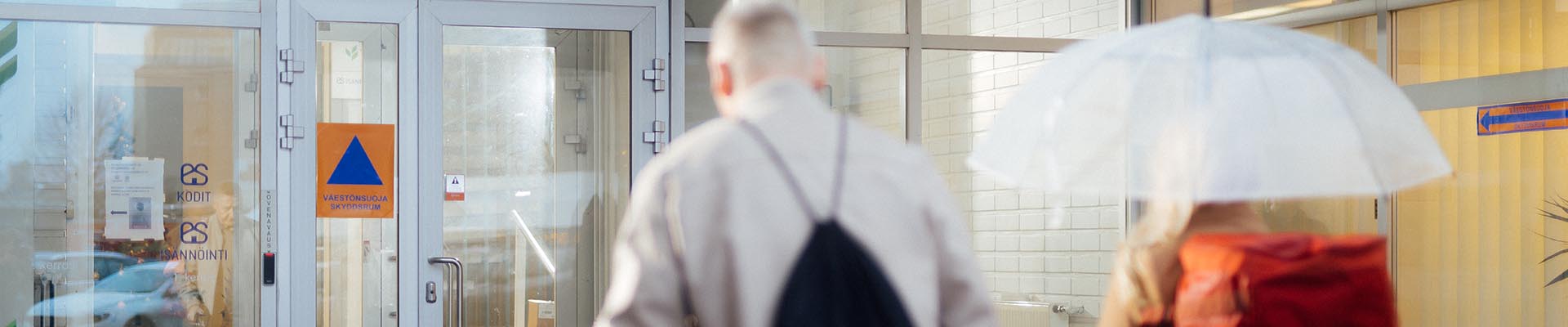
Civil defense shelters are marked with the international symbol: a blue equilateral triangle on an orange background.
Civil defense shelters are commonly located in apartment buildings, row houses, schools, hospitals, shopping centers, office buildings, and other large structures. Anyone in need of protection can use a shelter if space is available.
In a real situation, protection would occur where you are at the time of the alert. If there is no shelter nearby, seek protection indoors.
Information about a property’s shelter, such as in an apartment building, or the nearest public shelter is often found in the property’s rescue plan. There is no nationwide map of all shelters in Finland.
More information on preparedness in your area can be found on your regional rescue service’s website.
Civil defense shelters are not the only way to protect the population. Protection is arranged using other appropriate methods for the situation and location.
Other methods include seeking shelter indoors, temporary shelters, voluntary relocation to a safer area, and evacuation by authority order.
If there is no shelter nearby, the basic instruction is to seek shelter indoors and stay as close as possible to strong structures, such as the central parts of a building.
The obligation to build civil defense shelters applies nationwide. According to the Rescue Act, a shelter must be built during construction at the developer’s expense in a building or group of buildings on the same plot with a floor area of at least 1,200 m² and used for permanent residence or work. For industrial buildings, the limit is 1,500 m².
The building owner or holder, such as the housing company’s board, is responsible for the maintenance and upkeep of the shelter.
Activation and use of the civil defense shelter require planning. The plan is prepared by the building holder and is part of rescue planning. A good practice is to train some residents or users in shelter activation and use.
Other users can be provided with general information about the shelter’s location, operating principles, preparedness for disruptions and crises, and instructions for action if shelters are taken into use.
Read more:
Under normal conditions, shelters can be used as hobby spaces or storage.
According to the Rescue Act, the shelter and its equipment must be kept in such condition that it can be taken into use within 72 hours by authority order.
A civil defence shelter has to have strong structures and at least two independent reinforced exits. It also has to have its own ventilation system that works even without electricity. The ventilation system can filter incoming air from toxic gases or radioactive substances if necessary.
Civil defence shelters vary in size, location, construction date, and equipment, so material preparedness needs differ.
Watch the Ministry of the Interior’s YouTube video on shelters. (In Finnish)
Shelters are taken into use by authority order when there is a threat of war. They are not activated suddenly.
The need for protection is announced by the general warning signal (a siren with rising and falling tone for one minute) and an official emergency alert. If you cannot reach a civil defense shelter within a few minutes, seek protection indoors.
Read more:
Keep your ID, essential medications, phone, a small amount of cash, and drinking water with you. The need for protection may arise quickly, leaving no time to gather supplies.
Take to the shelter:
- Drinks and food that can be consumed without heating.
- Hygiene supplies.
- Equipment for overnight stay and comfort (e.g., sleeping bag and mat).
- Headlamp or flashlight that works with batteries or without mains power.
- Power bank for charging mobile phones and devices.
- Earplugs and eye mask for sleeping.
- Items for leisure (books, games, toys, paper, pens).
Shelters may be crowded and warm, but they are safe spaces. Stays are usually short.
Follow instructions and maintain cleanliness. Do not smoke or use devices that increase fire risk.
Cooperation, calm behavior, and consideration for other persons make shelter stays smoother.
civil defence shelters are primarily designed for people. Exceptions are guide dogs, which must be allowed to accompany their owners.
The confined spaces in shelters can cause stress and anxiety for animals. The safest and least stressful place for a pet is at home. Shelters are generally used only for short periods.


